For the past week, hundreds of activists—from celebrities and scientists to ordinary citizens—have come to Washington to protest the proposed Keystone XL pipeline, which would bring up to 500,000 barrels of crude a day from western Canada’s oil sands. Scores of those activists have been arrested, but more keep coming every day, …
2010 was a pretty serious year for Atlantic hurricanes. The season tied with 1995 and 1887 for the third largest number of named storm, with 19, and tied with 1969 for the second largest number of hurricanes, with 12. One of those hurricanes—Earl—reached Category 4 status, with winds hitting a maximum of 145 mph, stronger than …
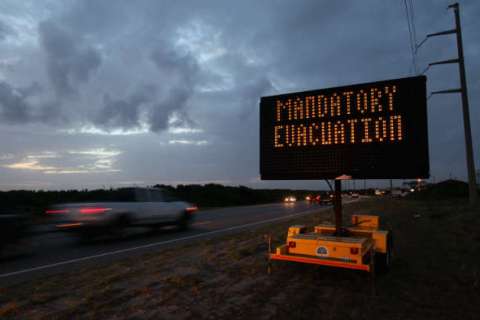
Hurricane Irene’s cone of uncertainty is getting downright scary. The Category 3 hurricane has already slammed the Bahamas, and the latest forecasts have the storm missing Florida but running into the North Carolina coast on …
For several years now, a few academics have been fighting a civil war over the possible effects of climate and global warming on, well, civil war. In 2009 Marshall Burke, an economist at the University of California-Berkeley, co-authored a paper arguing that higher temperatures increased the risk of civil conflict—and that the warming …
Come on, Irene — it’s hurricane season. Hurricane Irene, which slashed across Puerto Rico earlier this week and just missed the Dominican Republic, is headed for the southeastern U.S. Irene is expected to strengthen to Category 3 and could become a Category 4 storm, with at least 131-m.p.h. winds as it approaches the southeastern …
Personally, I was in the bathroom in TIME’s midtown Manhattan office building, and I didn’t feel a thing—until I got on Twitter. The news moved faster digitally than it did geologically: southwestern Virginia had suffered a 5.8-magnitude earthquake, one apparently strong enough to be felt from Georgia up to Ontario. [Update: USGS …
One of the hottest points of debate on aquaculture is the effect that farmed fish might have on their wild cousins. Fish raised in a major aquaculture operation live in close, sometimes cramped conditions that are nothing like the open ocean. As a result, they can become victims of disease and parasites—just as for centuries human …
The news has been relatively good recently out of the crippled Fukushima Daiichi nuclear plant. Tokyo Electric Power (TEPCO), the plant’s operator, last week reported success in sharply reducing radiation levels within the plant, and in stabilizing temperatures in the pools of water need to store used nuclear fuel rods. While …
Back in 2008, former vice president Al Gore decided that it was time to take the fight against climate change to a new level. Speaking at the annual meeting of the Clinton Global Initiative, Gore said that the world had “reached the stage where it is time for civil disobedience,” and called for young people to take the lead. The …
Usually infectious disease is a one-way street—and human beings are at the end. New viruses begin in wild animals—like monkeys or chickens—before they mutate and cross over to human beings. HIV, West Nile, SARS, H5N1, H1N1—just about every new infectious disease over the past several decades had its start in animals before …

 EcocentricOil